Oxford / Applied AI
AI voice agent & officer routing
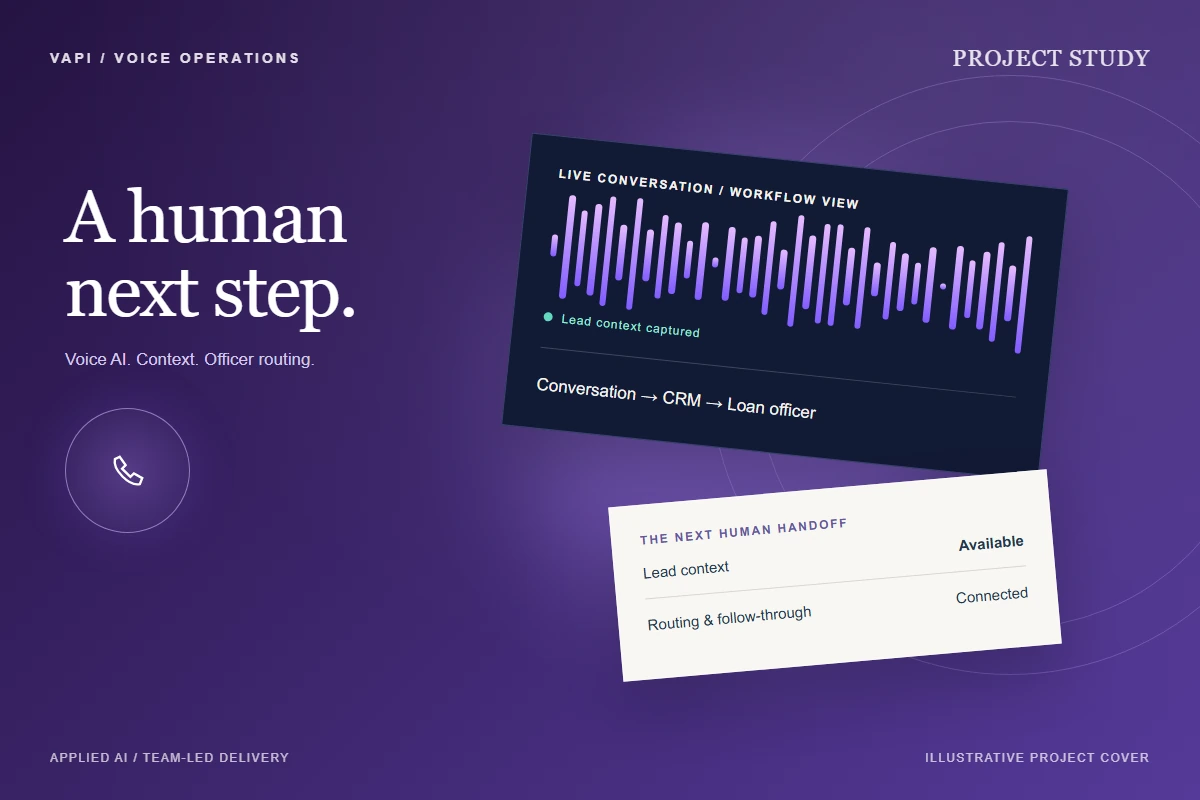
Led the team building an AI voice workflow, working alongside them to connect lead conversations, loan-officer routing, and handoff reporting.
LOGAN PACK, MBA · AI ENGINEER
I BUILD
WHAT’S
NEXT.
AI. Data. Marketing.
Built to work together.
Discover the work
↗
STRATEGY IN MIND. HANDS IN THE BUILD.
SCROLL TO CONNECT THE DOTS
THE THROUGH-LINE
I work where disciplines meet.
And possibilities become
working systems.
AI engineer. Marketing technologist. Business operator.
One perspective across the whole journey.
THE EVIDENCE / DIRECT-MAIL BUSINESS OUTCOMES
$582.85
M
Funded principal · Mar 2025–Sep 14, 2026
$30.94
M
Direct-mail-attributed revenue.
Mar 2025–Sep 14, 2026.
1,766
Direct-mail-attributed funded loans.
Each funded loan counted once.
Read the scope. Follow the evidence.
I joined Oxford in March 2025 and helped scale an established direct-mail program. These are campaign-attributed funded outcomes from March 1, 2025 through September 14, 2026, not an estimate of personal incremental lift. Total loan volume is funded principal; branch revenue is a separate accounting measure, not profit. Loans closed uses funded loans, with each loan counted once.
Direct-mail data, attribution & source definitions
THE WORK BEHIND THE CONNECTIONS
01 / DATA ARCHITECTURE
↗
02 / APPLIED AI
↗

03 / CUSTOMER EXPERIENCE
↗
TEAM-LED DELIVERY + HANDS-ON BUILDING
14 PROJECTS / 04 DISCIPLINES
THE BODY OF WORK
The full picture.
Four disciplines. 14 projects.
AI ENGINEERING / 02 PROJECTS
Intelligence,
put to work.
Agents, tools, and human handoffs. I connect AI to the work a business actually needs to do.
SELECT A PROJECT TO EXPLORE ITS ROLE IN THE SYSTEM.
01
TEAM-LED AI DELIVERY
Voice intake connected to CRM routing and measurable follow-through.
THE QUESTION
How does an AI conversation become a useful next step for a person?
MY CONTRIBUTION
I led the team and worked alongside specialists to connect the voice experience, officer routing, and handoff reporting.
02
CUSTOM INTEGRATION DEVELOPMENT
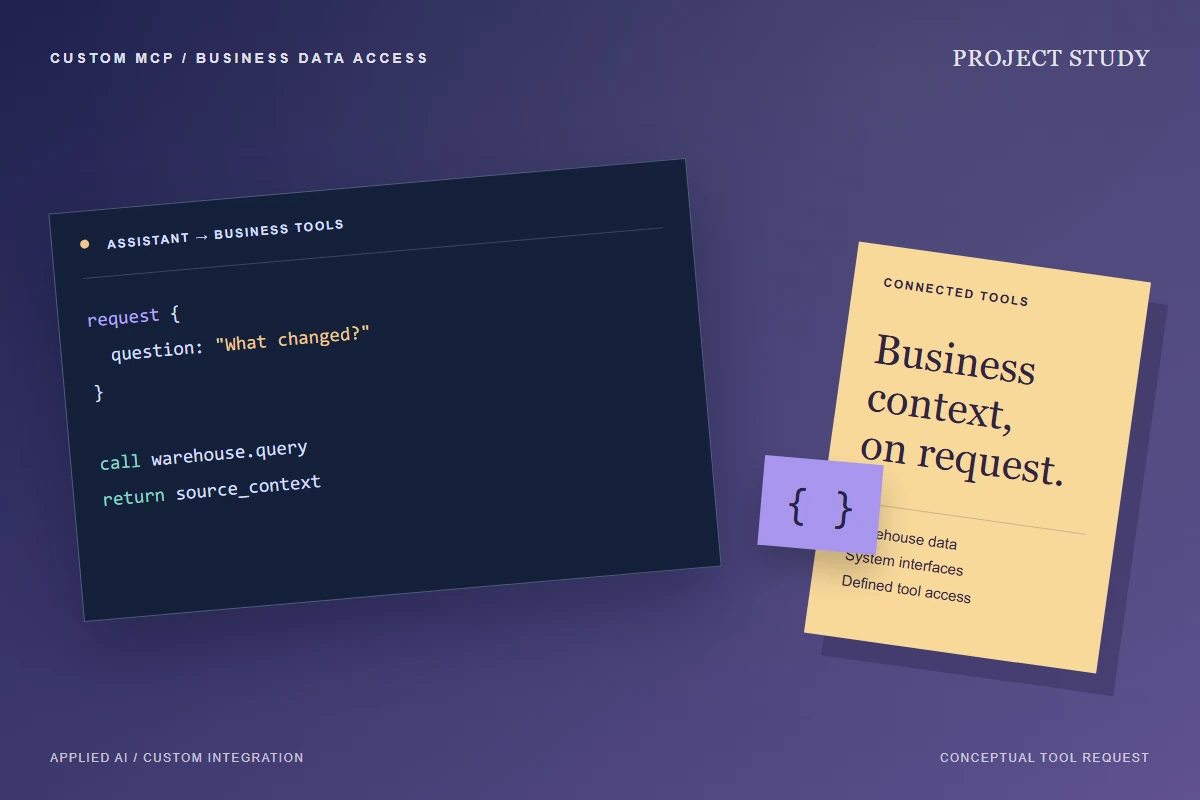
A defined path from an assistant’s question to business tools and warehouse context.
THE QUESTION
Can the answer be traced to the information and tools behind it?
MY CONTRIBUTION
I built custom MCP connections between assistants, tools, and business data.
BIG DATA & INTELLIGENCE / 03 PROJECTS
Complex data.
Clear decisions.
The foundation beneath the intelligence: connected records, reusable models, and reporting a team can act on.
SELECT A PROJECT TO EXPLORE ITS ROLE IN THE SYSTEM.
01
DATA ARCHITECTURE & DEVELOPMENT
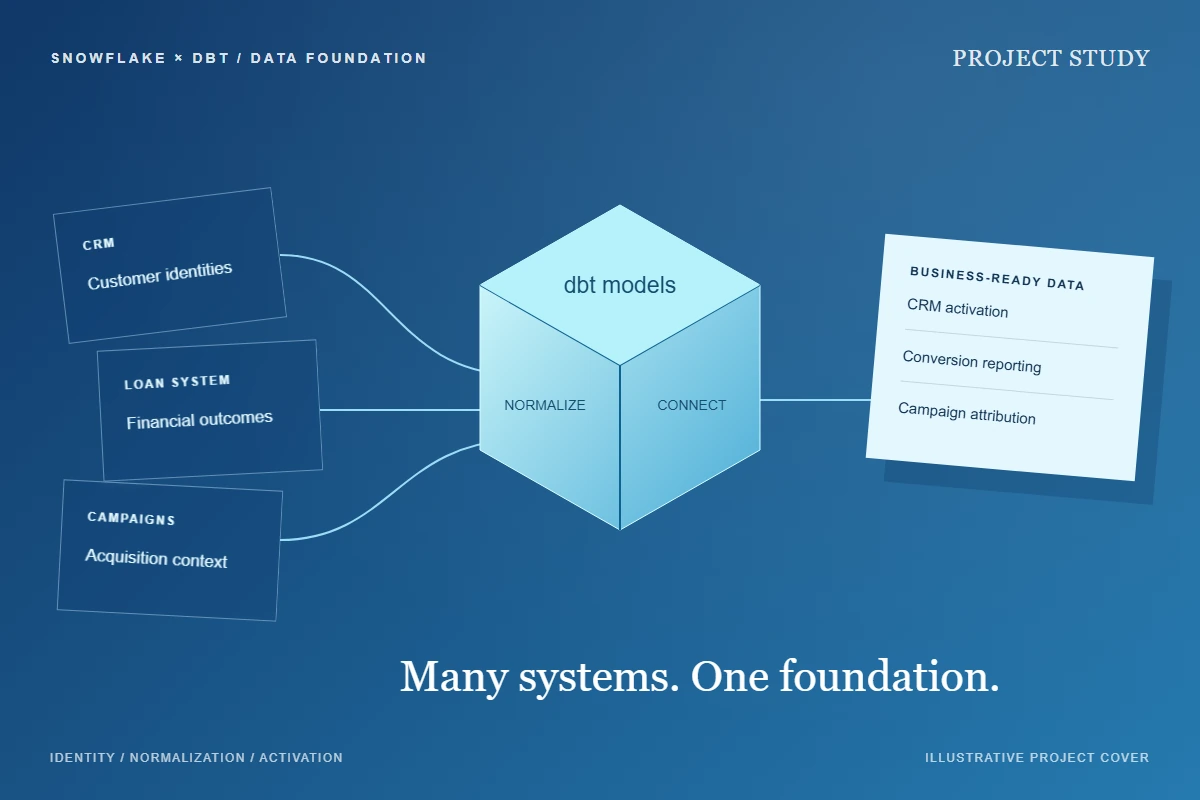
CRM, loan, and campaign data connected through reusable models.
THE QUESTION
Do the records, identities, and definitions agree before a decision is made?
MY CONTRIBUTION
I worked on data architecture and dbt development to turn disconnected records into a common reporting foundation.
02
ARCHITECTURE & MIGRATION PLANNING
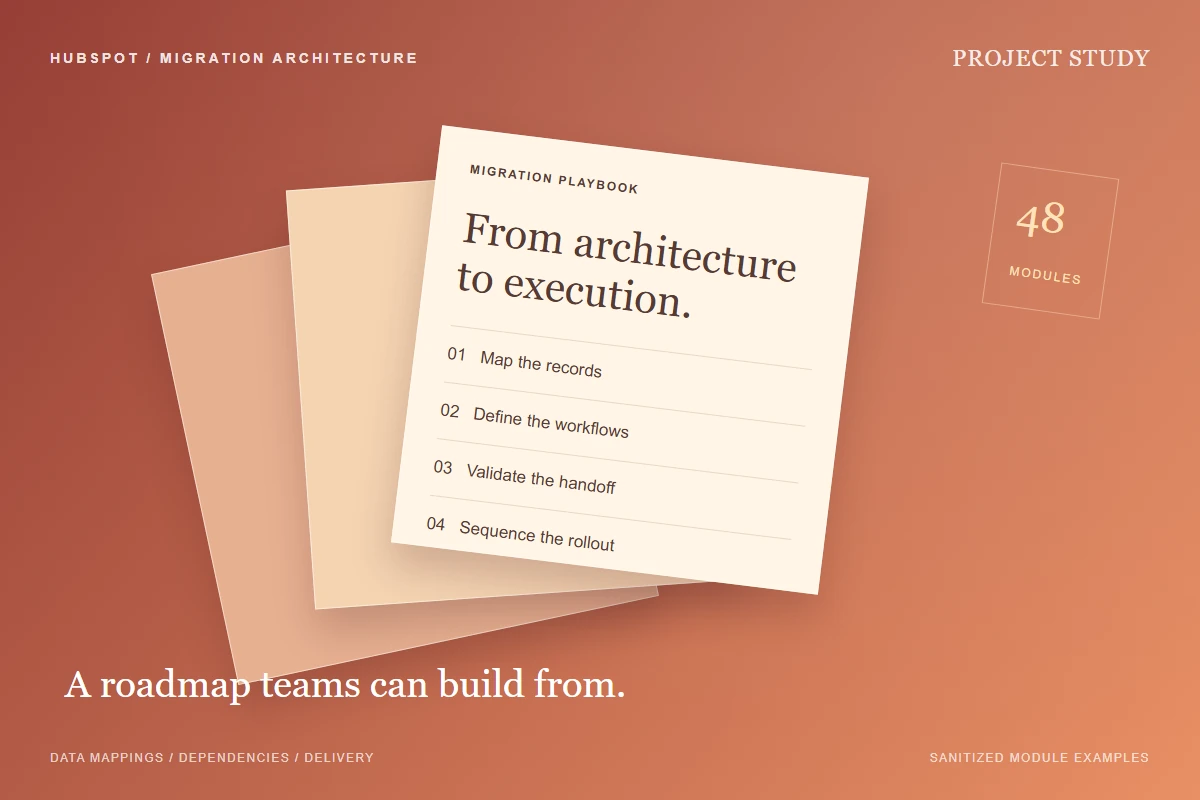
Source mappings, dependencies, and a staged delivery roadmap.
THE QUESTION
How can a team change platforms without losing the operating context?
MY CONTRIBUTION
I defined data mappings, dependencies, and the migration-planning roadmap.
03
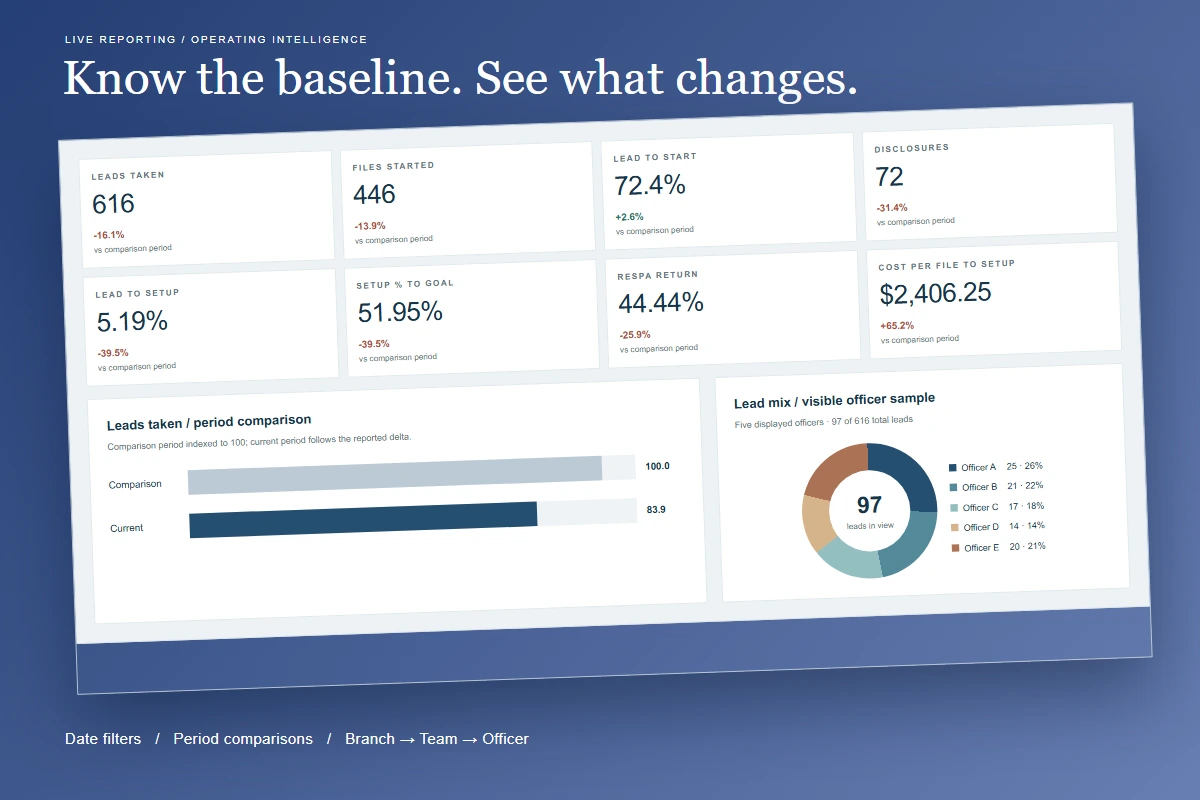
REPORTING AUTOMATION & ANALYSIS
Recurring visibility across branches, teams, and loan officers.
THE QUESTION
Where does customer interest progress—and where does it stall?
MY CONTRIBUTION
I built automated performance snapshots to make lead progression easier to inspect.
PERFORMANCE MARKETING / 02 PROJECTS
Find the signal.
Move the business.
Connect acquisition to downstream quality. Keep channel activity, attributed outcomes, and modeled opportunities distinct.
SELECT A PROJECT TO EXPLORE ITS ROLE IN THE SYSTEM.
01
DIGITAL GROWTH & ACQUISITION SYSTEMS
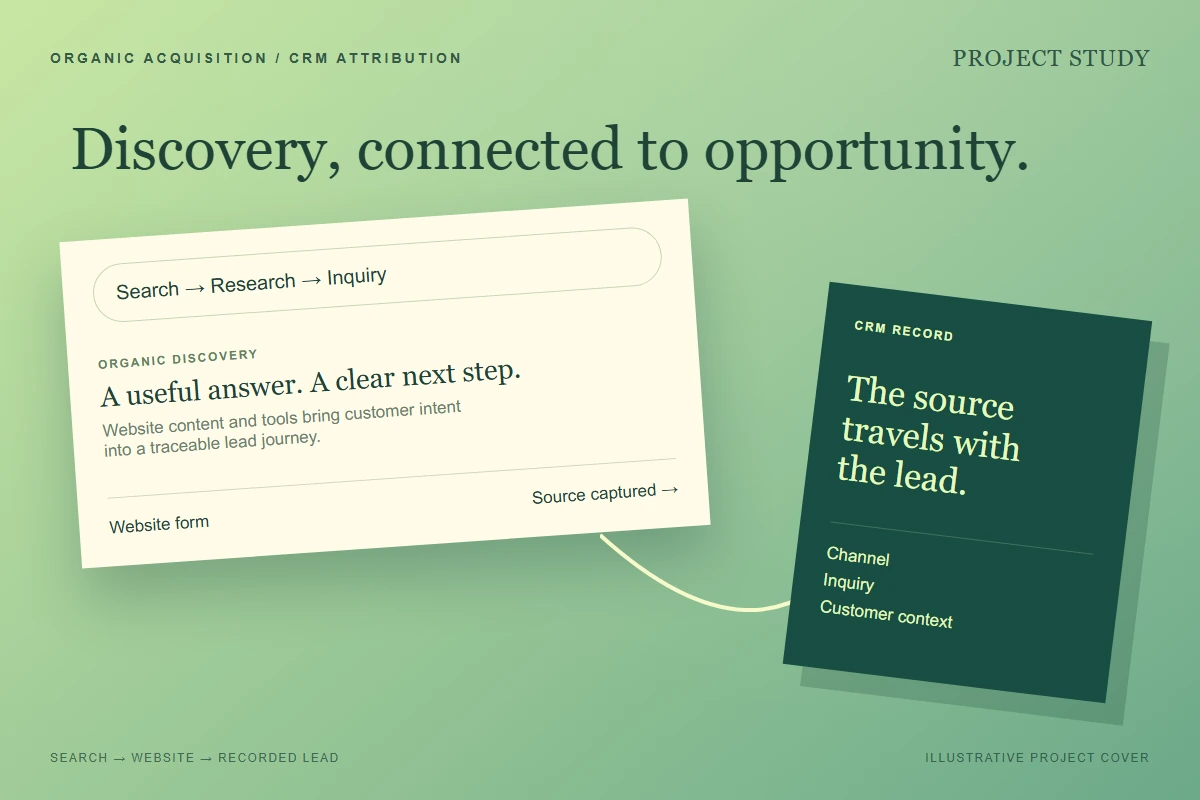
Digital discovery and forms connected to recorded leads and source context.
THE QUESTION
What happens after a visitor becomes a lead?
MY CONTRIBUTION
I connected lead capture, acquisition context, and CRM records.
02
MODELED SCENARIO · SYNTHETIC DATA
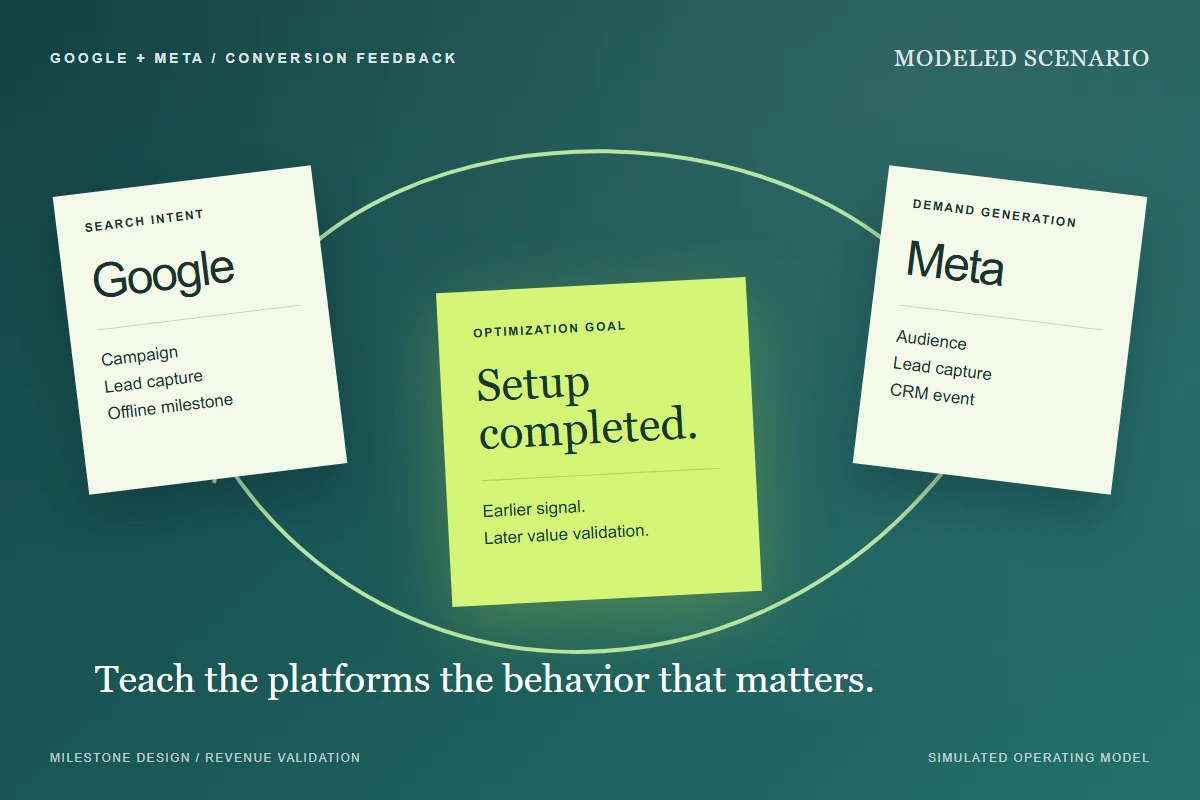
A company-neutral model moving optimization toward a verified earlier milestone.
THE QUESTION
Which earlier behavior offers a useful learning signal while revenue validates quality?
MY CONTRIBUTION
I designed the funnel model, milestone selection, and platform activation architecture. This is a portfolio simulation, not client campaign performance.
MARKETING TECHNOLOGY / 07 PROJECTS
Make the whole
experience work.
From the first impression to the operational handoff: websites, workflows, and customer systems designed to connect.
SELECT A PROJECT TO EXPLORE ITS ROLE IN THE SYSTEM.
01
WORKFLOW DESIGN & AUTOMATION
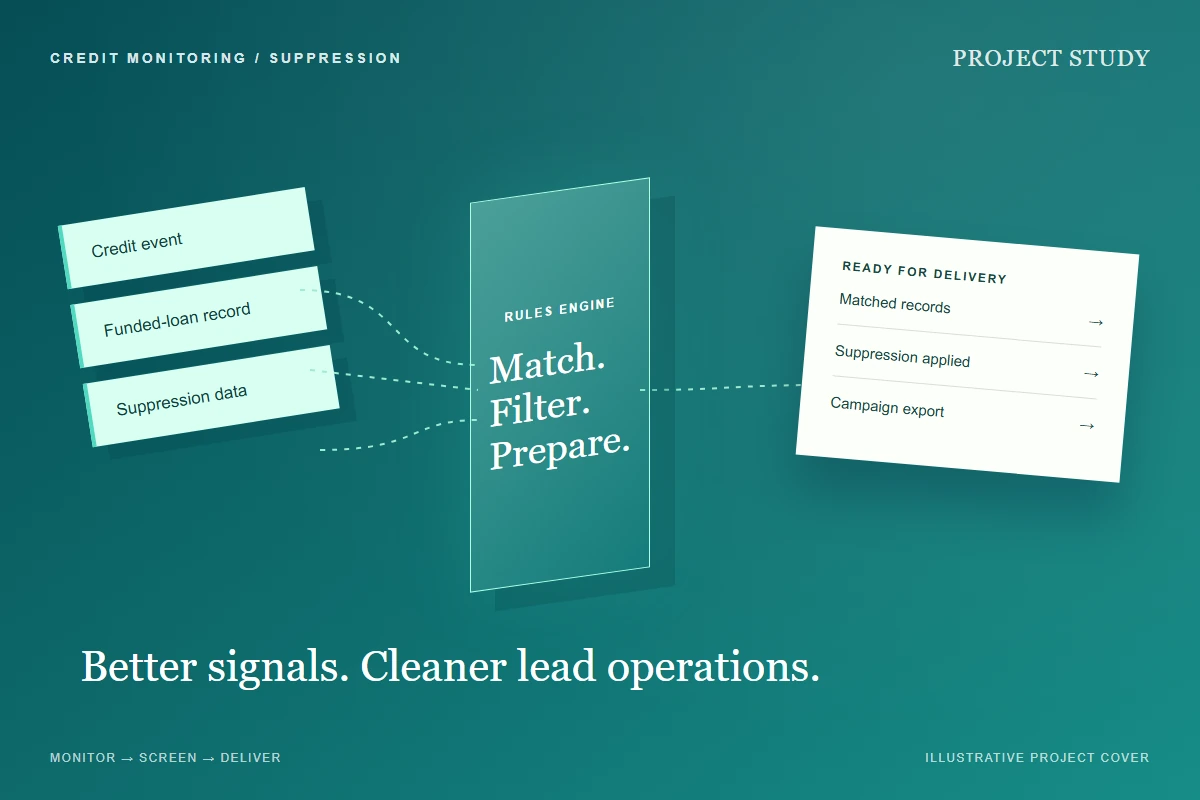
Credit-event processing, suppression checks, and campaign-ready delivery.
THE QUESTION
How does a signal become a usable operational input?
MY CONTRIBUTION
I designed and automated workflows connecting credit events, suppression checks, and data delivery.
02
OPERATIONAL WORKFLOW AUTOMATION
Batch screening connected to CRM status updates and processing summaries.
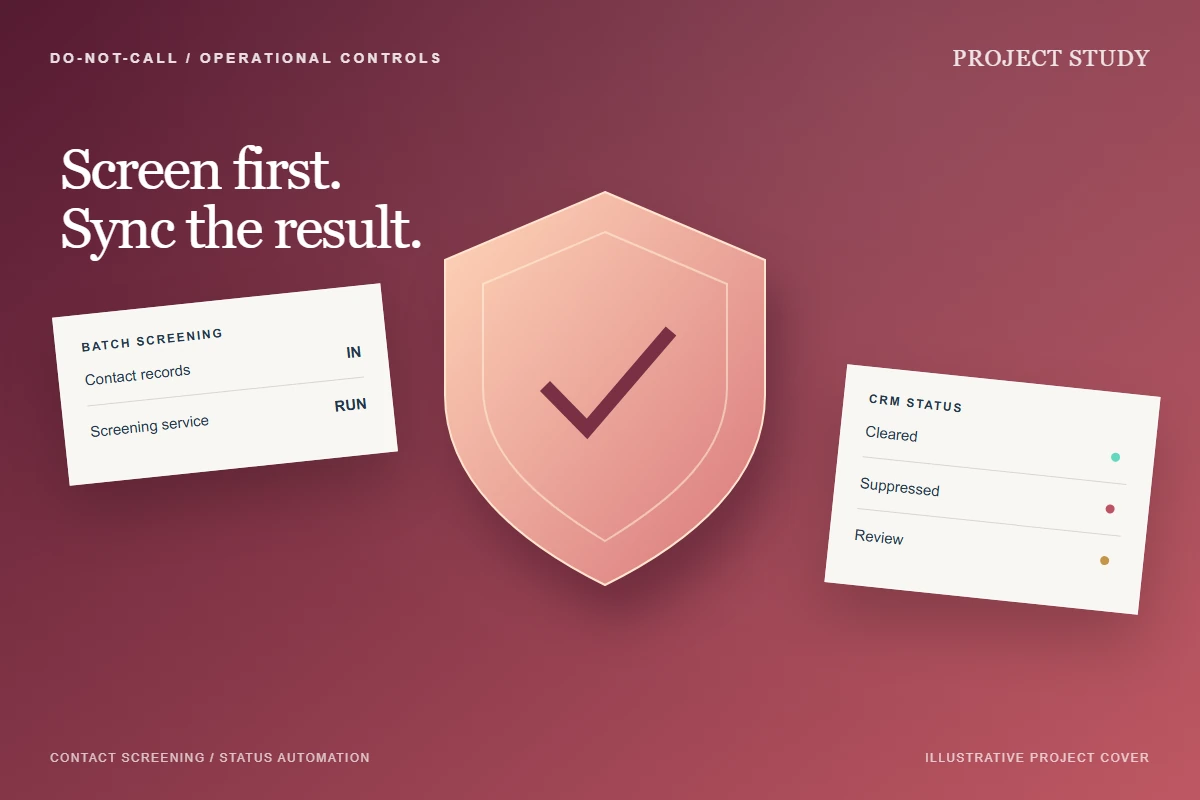
THE QUESTION
How does screening information reach the people and systems using it?
MY CONTRIBUTION
I connected contact screening with CRM updates and operational reporting.
03
PRODUCT DESIGN & APPLICATION DEVELOPMENT
An officer-personalized experience for collecting customer feedback.
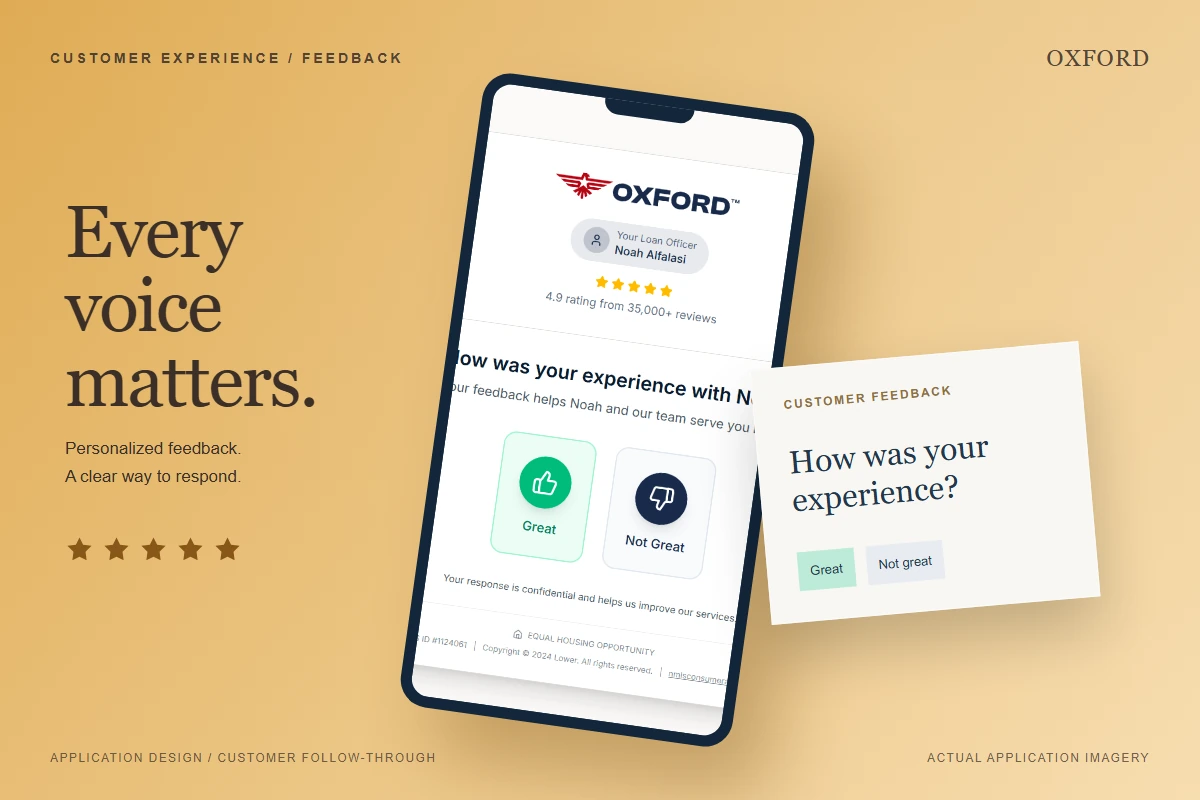
THE QUESTION
Can the feedback experience feel personal and remain operationally useful?
MY CONTRIBUTION
I built an application connecting the customer feedback journey with officer context.
04
BRICK HOUSE BLUE · TEAM-LED WEBSITE
Brand, locations, and service discovery connected to inquiry paths.
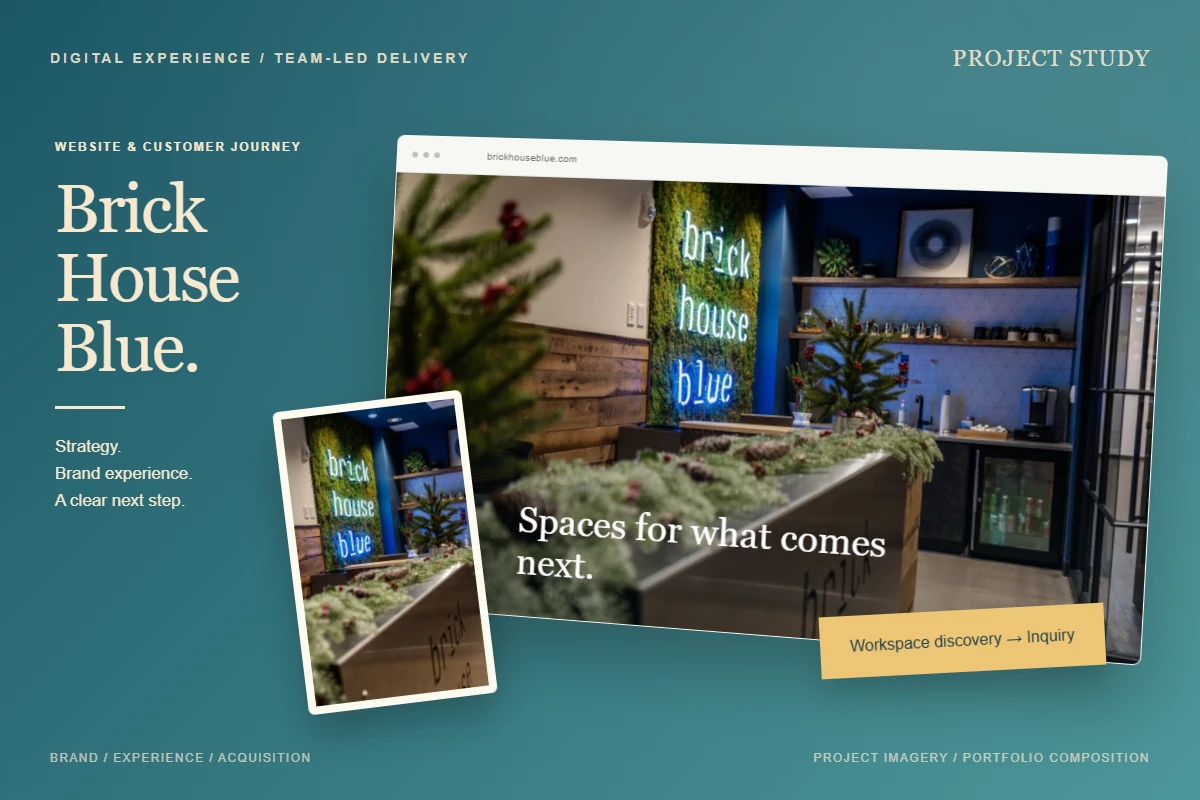
THE QUESTION
Can a prospective customer find the right space and take a clear next step?
MY CONTRIBUTION
I led the website team and collaborated on the experience from brand and service discovery to inquiry.
05
OXFORD HOME LENDING · TEAM-LED PLATFORM
Mortgage content, customer tools, and attributed lead capture.
THE QUESTION
How does a large digital experience support both customer intent and measurement?
MY CONTRIBUTION
I led platform strategy and the website team, working with Vladyslav Kuzmenko on design and development.
06
ROUGE AESTHETICS · TEAM-LED WEBFLOW
Treatment discovery connected to a clear consultation journey.

THE QUESTION
Can a visitor make sense of the offering before starting a conversation?
MY CONTRIBUTION
I led the team building the Webflow experience and collaborated on service discovery and consultation paths.
07
WATER LILY · TEAM-LED WEBSITE
A distinctive service brand translated into clear offerings and next steps.
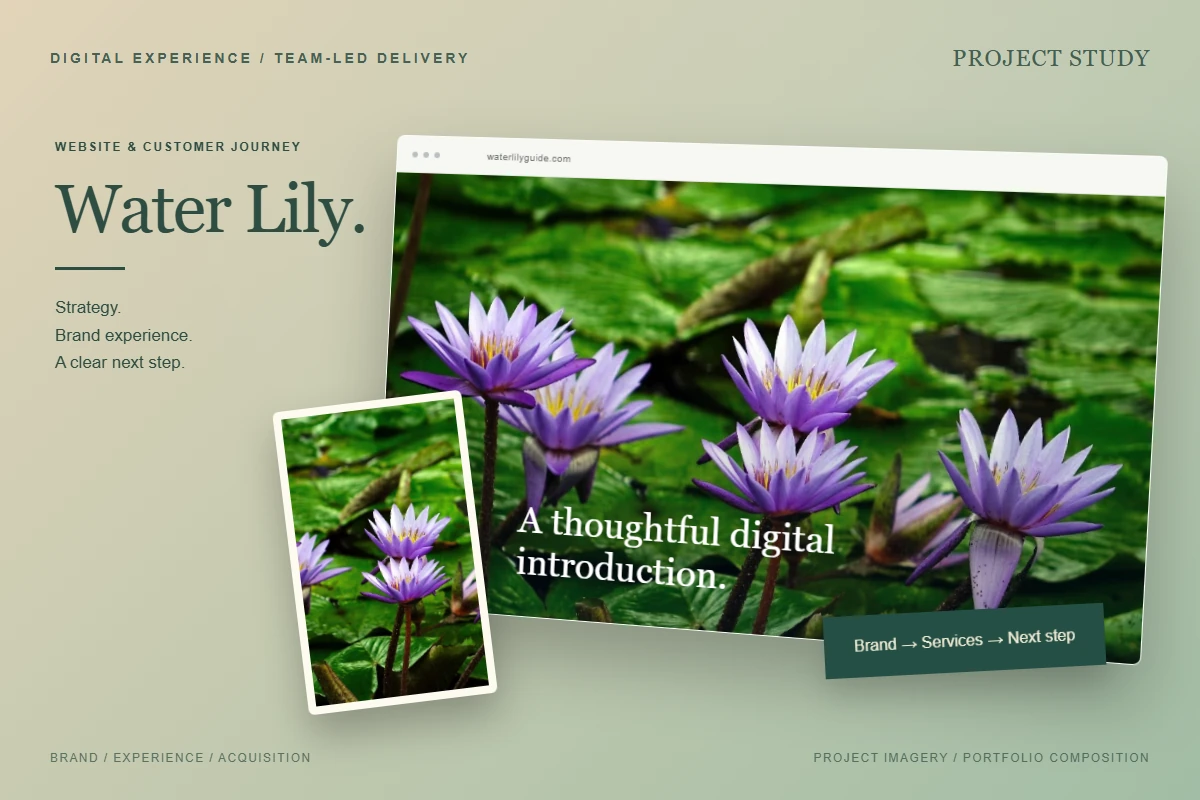
THE QUESTION
How can the service and the person behind it come through clearly?
MY CONTRIBUTION
I led the team translating the brand into a website experience.
THE NEXT MOVE IS HUMAN.
Lead the team.
Stay in the work.
LOGAN PACK, MBA
AI ENGINEER. BUSINESS OPERATOR.
CURIOUS BY DEFAULT.
I work across the boundaries most teams have to bridge: engineering, marketing, operations, and data.
I build hands-on and lead alongside specialists. The aim is lasting capability: systems people can understand, evaluate, and keep improving as AI moves forward.
01
Multi-agent orchestration
Specialized agents, explicit responsibilities, deliberate context handoffs, and review before action. A human remains accountable for the outcome.
02
Multi-model discipline
Choose models against the task, quality, latency, and cost. Keep interfaces clear enough to adopt a better model without rebuilding the business process.
03
Layered data protection
Consider what every step may read, retain, and change. Scope access, minimize context, validate consequential actions, and keep the handoffs traceable.
04
Capability that compounds
Leave the team with understandable architecture, documented decisions, clear ownership, and feedback that informs the next iteration.
YOUR NEXT ADVANTAGE STARTS WITH A CONVERSATION.
logan.pack6@gmail.com ↗LET’S
BUILD
SELECTED WORK
Team-led delivery and hands-on work across growth operations, data infrastructure, and digital acquisition. Each project explains the problem, my contribution, and the evidence.
01
Turn customer interest into a connected, measurable operating process.
Oxford / Applied AI
Led the team building an AI voice workflow, working alongside them to connect lead conversations, loan-officer routing, and handoff reporting.
Oxford / Lead operations
Automated credit-event processing, suppression checks, and campaign-ready data delivery.
Oxford / Contact controls
Connected batch contact screening to CRM status updates and processing summaries.
Oxford / Customer experience
Built an officer-personalized application for collecting feedback after the customer experience.
Oxford / Digital acquisition
Connected digital discovery and website forms to recorded leads and channel attribution.
02
Connect the underlying records, tools, and decisions that support growth.
Oxford / Data infrastructure
Unified CRM, loan, and campaign data into reusable models for reporting and operations.
Oxford / CRM transformation
Defined the data mappings, dependencies, and delivery roadmap for a CRM migration.
Oxford / Sales visibility
Built a live reporting baseline with date filters, period comparisons, and branch-to-officer visibility into volume, conversion, goals, and cost.
Oxford / AI integration
Connected AI assistants to business systems through purpose-built tools and data access.
Company-neutral / Modeled scenario
Designed a modeled feedback system that makes setup completion the campaign’s optimization win.
03
Lead teams translating brand and acquisition strategy into customer journeys.
Brick House Blue / Website
Led the team creating a workspace website that connects brand, locations, and service discovery to clear inquiry paths.
Oxford Home Lending / Website
Led the website team and worked alongside design and development to connect mortgage content, customer tools, and attributed lead capture.
Rouge Aesthetics / Webflow
Led the team building a Webflow experience that makes treatment options clear and guides visitors toward consultation.
Water Lily / Website
Led the team translating a service brand into a distinctive website with clear offerings and customer next steps.
DIGITAL GROWTH PLATFORM
Led the website team and worked alongside design and development to connect mortgage content, customer tools, and attributed lead capture.
Team leadership, platform strategy & collaborative delivery
Explore the live experienceTHE PROBLEM
Mortgage choices and next steps can be difficult to navigate online.
HOW I LED & CONTRIBUTED
Led platform strategy and the website team, working with Vladyslav Kuzmenko on design and development and connecting the experience to lead capture.
WHY IT MATTERS
Structured content and customer journeys connect the website to the wider acquisition and measurement system.

02 / HOW THE PARTS CONNECT
Structure the experience around customer questions and mortgage goals.
Carry acquisition information into the CRM and reporting foundation.
Connect content and tools with clear inquiry paths.
BRAND EXPERIENCE / WEBFLOW
Led the team building a Webflow experience that makes treatment options clear and guides visitors toward consultation.
Website team leadership & collaborative execution
Explore the live experienceTHE PROBLEM
A broad treatment offering can be hard to assess before a consultation.
HOW I LED & CONTRIBUTED
Led the website team and collaborated on service structure, visual experience, and the consultation path.
WHY IT MATTERS
Makes the offering easier to explore and discuss with the team.

02 / HOW THE PARTS CONNECT
Introduce the practice through a welcoming visual experience.
Connect uncertainty to a clear consultation path.
Make treatment categories and common questions easy to explore.
Live Rouge Webflow site inspected September 10, 2026. Website contribution supplied by Logan. Outcome describes the implemented journey, not a measured conversion increase.
BRAND & DIGITAL EXPERIENCE
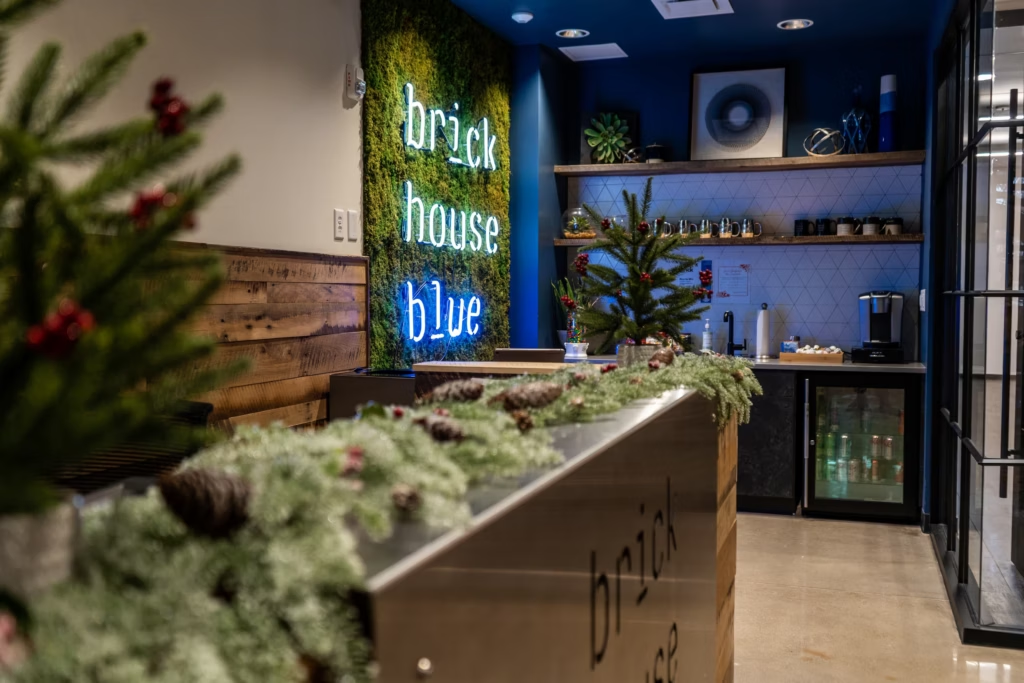
Led the team creating a workspace website that connects brand, locations, and service discovery to clear inquiry paths.
Website team leadership & collaborative execution
Explore the live experienceTHE PROBLEM
Visitors arrive with different needs for offices, coworking, meetings, and events.
HOW I LED & CONTRIBUTED
Led the website team and worked alongside them on the brand presentation, location structure, and inquiry journey.
WHY IT MATTERS
Helps prospective customers find the right space and next step.
02 / HOW THE PARTS CONNECT
Separate workspace, meeting, office, and event intentions.
Give interested visitors a clear inquiry path.
Connect the service to the relevant space and location.
Live website. Portfolio contribution supplied by Logan.
SERVICE BUSINESS & BRAND
Led the team translating a service brand into a distinctive website with clear offerings and customer next steps.
Website team leadership & collaborative execution
Explore the live experienceTHE PROBLEM
The website needs to communicate both the service and the person behind it.
HOW I LED & CONTRIBUTED
Led the website team and worked alongside them to connect brand presentation, service discovery, and the customer journey.
WHY IT MATTERS
Gives prospective clients a clear introduction and next step.

02 / HOW THE PARTS CONNECT
Introduce the story and perspective behind the service.
Provide a natural invitation to get in touch.
Make service information clear and approachable.
Live website. Portfolio contribution supplied by Logan.
AUTOMATION / OXFORD
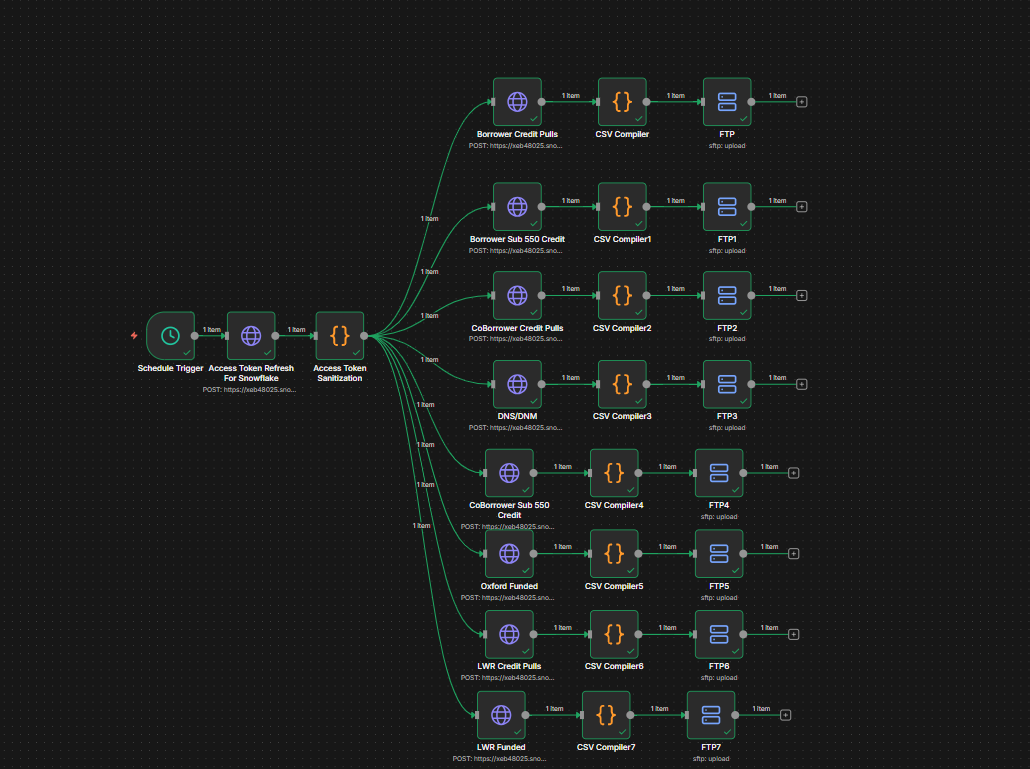
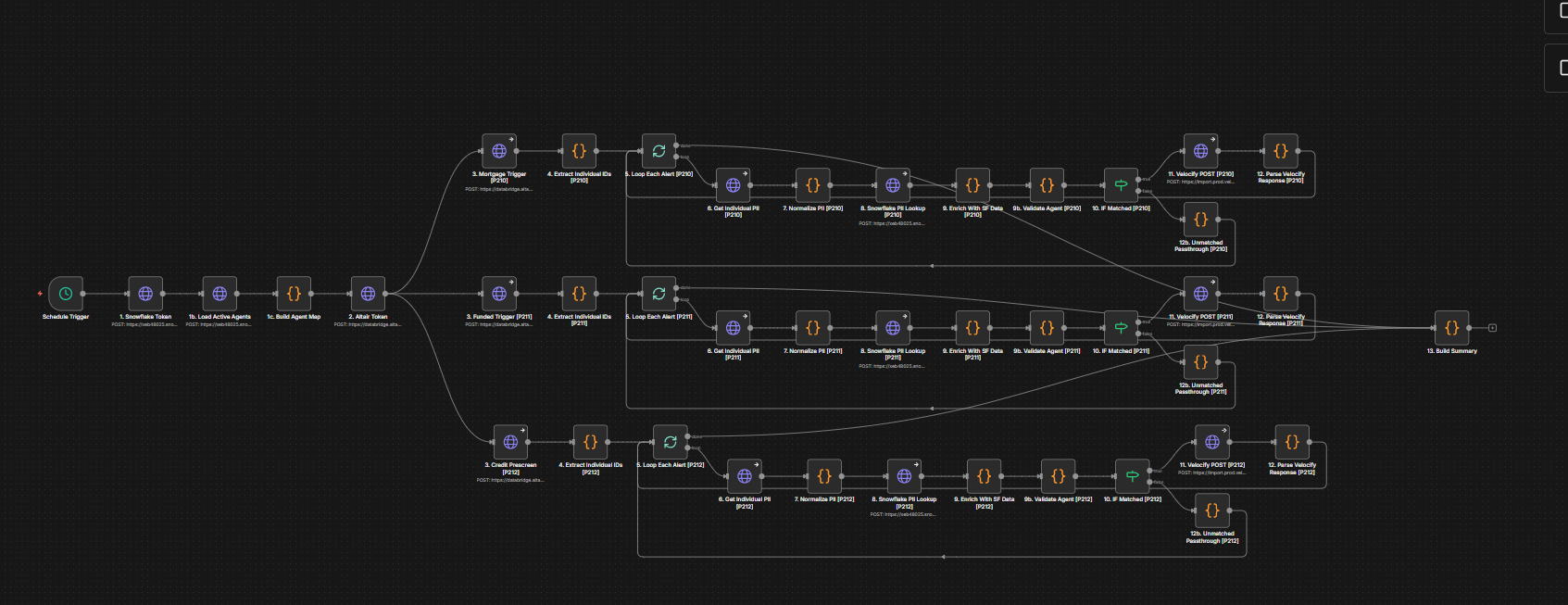
Automated credit-event processing, suppression checks, and campaign-ready data delivery.
Workflow design and automation
THE PROBLEM
Credit and funded-loan signals arrive through separate operational paths.
WHAT I BUILT
Connected monitoring feeds, record matching, suppression rules, and exports.
WHY IT MATTERS
Gives teams a repeatable way to prepare relevant lead activity.
02 / HOW THE PARTS CONNECT
Refresh source access and compile distinct credit and funding audiences.
Send matched records into the CRM and retain a defined unmatched path.
Resolve incoming records against the warehouse and validate officer context.
Two original workflow diagrams supplied by Logan.
OPERATIONAL CONTROLS / OXFORD
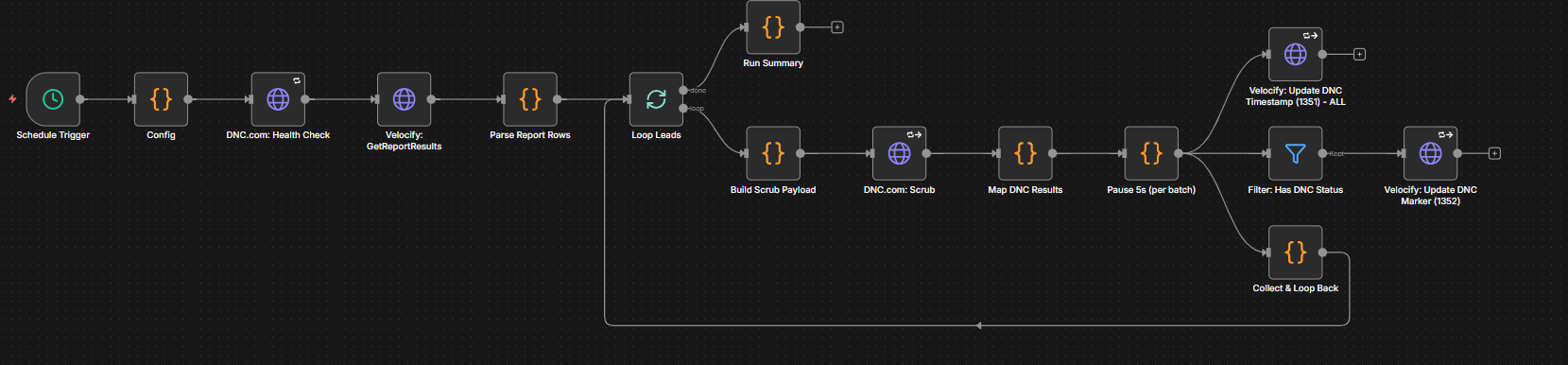
Connected batch contact screening to CRM status updates and processing summaries.
Operational workflow automation
THE PROBLEM
Screening results must reach the records that teams use for outreach.
WHAT I BUILT
Built batch scrubbing, result mapping, CRM updates, and run summaries.
WHY IT MATTERS
Makes contact-status screening a repeatable part of lead operations.
02 / HOW THE PARTS CONNECT
Check service availability and retrieve the CRM report.
Record timestamps and relevant markers, then pace the next batch.
Submit a batch and map returned statuses into a consistent structure.
Original workflow diagram supplied by Logan. The workflow is not a claim of complete legal compliance.
CUSTOM APPLICATION / OXFORD
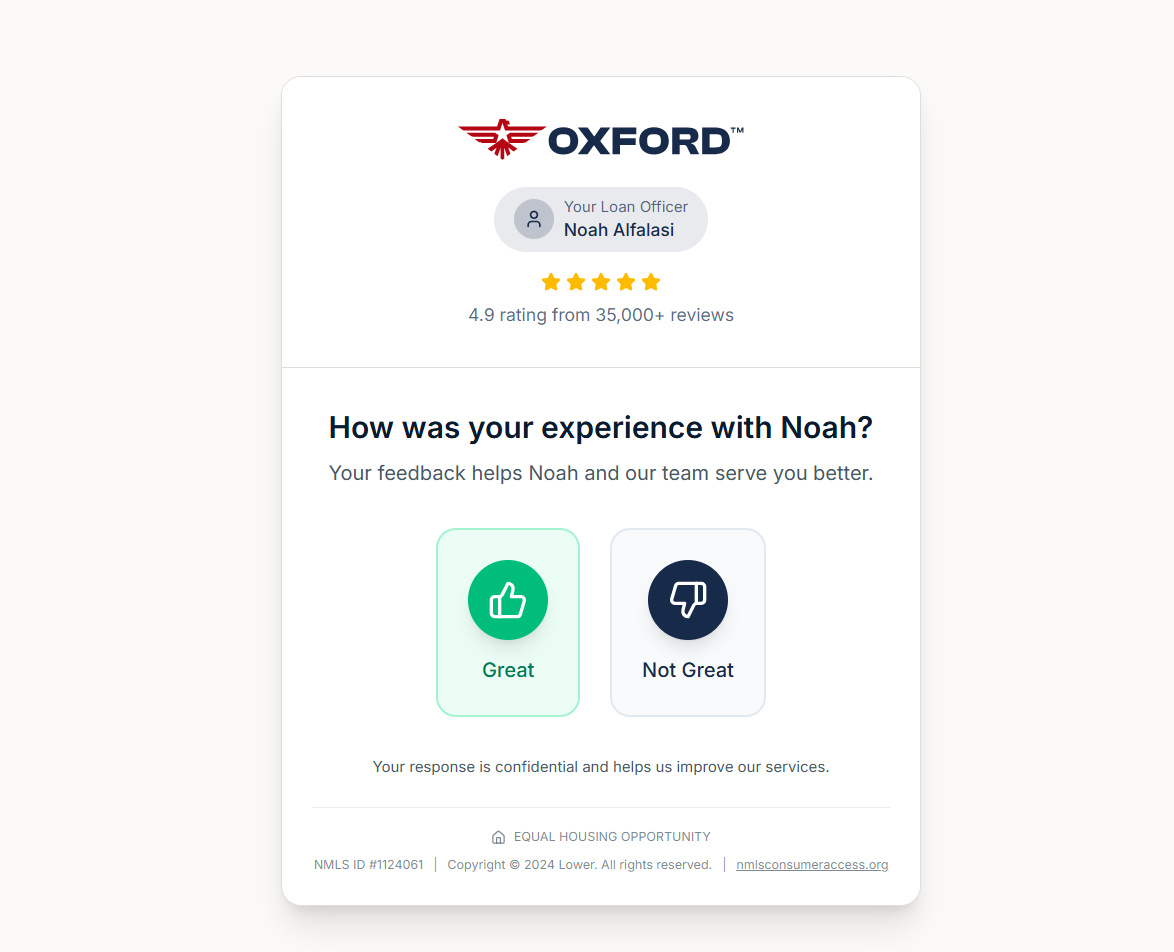
Built an officer-personalized application for collecting feedback after the customer experience.
Product design and application development
Explore the live experienceTHE PROBLEM
Customers need a straightforward way to share feedback with the team.
WHAT I BUILT
Created personalized feedback pages and response paths.
WHY IT MATTERS
Connects the customer, the loan officer, and the feedback process.
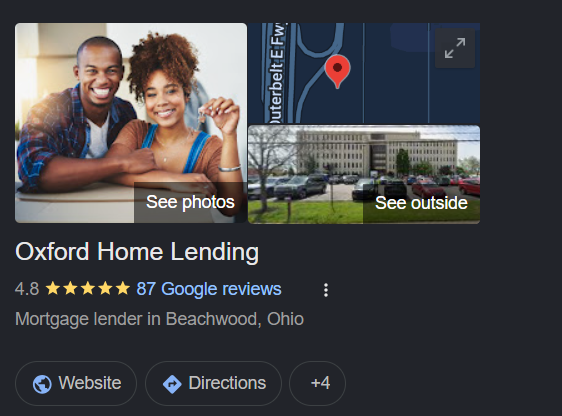
87 reviews
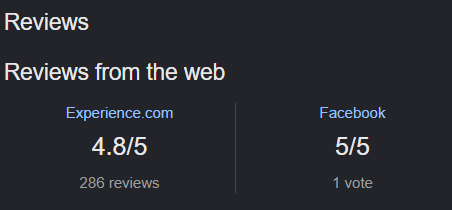
286 reviews
1 vote
Review-platform snapshots supplied by Logan. These describe Oxford’s visible ratings; they do not establish how many reviews the app generated or its incremental impact. See the original screenshots below.
02 / HOW THE PARTS CONNECT
Show the loan officer associated with the experience.
Connect the application story with independently scoped reputation snapshots.
Use a direct experience question and an understandable response choice.
Application screenshot, live app link, and review-platform screenshots supplied by Logan. Results were supplied September 9, 2026; the screenshot capture dates are not independently verified. These are platform snapshots, not app-attributed review counts or a before-and-after measurement. Platform populations may overlap and are not added together. The application screenshot’s 35,000+ review text has a different stated scope and is not used as a portfolio result.
VAPI CALL AGENT / OXFORD
Led the team building an AI voice workflow, working alongside them to connect lead conversations, loan-officer routing, and handoff reporting.
Team leadership, strategy & hands-on integration
THE PROBLEM
An AI conversation creates business value when the lead reaches the right person and the handoff can be measured.
HOW I LED & CONTRIBUTED
Led the build team and contributed alongside them to the voice-agent workflow, CRM routing, and officer-answer reporting.
WHY IT MATTERS
Routing records can be compared with matched officer answers, making follow-through visible beyond call volume.
Unique leads · July starts July 9. Select a month to explore its outcome mix. The periods have different lengths.
An answer requires positive officer talk time without a voicemail tag, matched within ±2 days of distribution. This measures matched follow-through, not direct transfer success.
02 / HOW THE PARTS CONNECT
Use the voice agent as part of the customer intake experience.
Compare distribution records with matched officer-answer evidence.
Connect the lead to the CRM’s officer-routing workflow.
Verified Snowflake routing and CTM call aggregates, September 9, 2026. A matched officer answer means positive non-voicemail talk time within ±2 days of distribution. This is not a Vapi platform call count or proof of a direct live transfer. Graphs show the verified monthly routing and matched-answer counts.
ORGANIC ACQUISITION / OXFORD
Connected digital discovery and website forms to recorded leads and channel attribution.
Digital growth strategy and acquisition systems
THE PROBLEM
Digital activity needs a traceable path into the CRM.
WHAT I BUILT
Connected lead capture with source context and CRM records.
WHY IT MATTERS
Makes organic acquisition visible beyond website traffic.
02 / HOW THE PARTS CONNECT
Create an experience that supports search-driven discovery.
Use explicit source and medium fields to distinguish organic inquiries.
Connect digital forms with CRM lead creation.
Aggregate Velocify records mirrored in OXFORD_MARKETING.CORE.LEAD_HISTORY, queried September 9, 2026. Counts reflect unique CRM lead IDs and current attribution fields, not incremental lift or qualified borrowers. Architecture graphic illustrates the journey.
AUTOMATED CONVERSION REPORTING
Built a live reporting baseline with date filters, period comparisons, and branch-to-officer visibility into volume, conversion, goals, and cost.
Dashboard strategy, reporting automation & performance analysis
THE PROBLEM
A headline total cannot explain whether performance changed because of lead volume, conversion, team execution, or cost. Leaders needed a shared baseline they could investigate.
WHAT I BUILT
Built a live, date-filtered dashboard spanning branches, teams, and loan officers, with period deltas, funnel milestones, setup targets, return rates, and cost per setup.
WHY IT MATTERS
Gives leaders a common view for daily standups and weekly reviews: spot a change, locate it in the funnel, and focus the next coaching or operating decision.
02 / HOW THE PARTS CONNECT
Choose today versus yesterday or comparable weekly periods. A consistent reporting window gives every team the same operating baseline.
Use the shared dashboard to prioritize coaching, review downstream conversion, and monitor whether the next period moves in the intended direction.
Compare changes in lead volume, conversion, setup goals, and cost; move from branch to team to loan officer to investigate the variance.
Logan built this as a live baseline dashboard with date filters and period comparisons for the team. This portfolio reconstructs the experience from supplied screenshots. The latest image contains 616 leads, 446 file starts, 72.4% lead-to-start, and 72 disclosures; its date range is not visible. The earlier September 1–10 screenshot is a separate snapshot. The supplied view preserves visible values and percentage deltas. Date-comparison examples use explicitly labeled sample data. Names are anonymized, and only the five visible officer rows are reproduced. No measured performance improvement is attributed to the dashboard.
SNOWFLAKE + DBT / OXFORD
Unified CRM, loan, and campaign data into reusable models for reporting and operations.
Data architecture and dbt development
THE PROBLEM
Fragmented systems make identities and outcomes difficult to reconcile.
WHAT I BUILT
Built staging, identity resolution, enriched models, and reporting views.
WHY IT MATTERS
Identity resolution and reusable models connect CRM operations, migration, attribution, and conversion reporting to a shared data foundation.
10 SECONDS / THE DATA FOUNDATION
CRM, loan finance, milestone, campaign, and web data begin with different structures. The animation starts with source data already available in the warehouse.
A simplified illustration inspired by my dbt architecture. Labels and examples are company-neutral. The 10-second sequence explains the process; it does not represent production runtime or a measured performance improvement.
02 / HOW THE PARTS CONNECT
Bring lead, loan, marketing, and CRM records into a shared environment.
Support migration, attribution, and repeatable operational reporting.
Establish identities and transform source data into useful business structures.
Original DAG screenshots supplied by Logan, local dbt models, and aggregate Snowflake queries. The 10-second video is a simplified, company-neutral illustration of the architecture; examples are synthetic and the timing is narrative, not measured production runtime.
ARCHITECTURE / MIGRATION LEADERSHIP
Defined the data mappings, dependencies, and delivery roadmap for a CRM migration.
Architecture and migration planning
THE PROBLEM
Moving CRMs requires agreement on data, workflows, and ownership.
WHAT I BUILT
Organized the migration into scoped modules and validation steps.
WHY IT MATTERS
Gives teams a clear sequence for implementation and acceptance.
I translated business operations into a connected architecture, documented the decisions and dependencies, and built a detailed plan for implementation. These six phases summarize the scope of a 48-module planning effort.
Discovery & scope
Map how people, data, and decisions move through the business.
| Layer | Responsibility | Handoff |
|---|---|---|
| Customer touchpoints | Capture requests and context | Validated inquiry |
| Operational workspace | Coordinate ownership and follow-up | Activity and outcome |
| Data platform | Resolve identities and model reporting | Consistent business context |
Why this mattersA shared definition of what the transition needs to preserve.
Identity & relationships
Translate fragmented records into a consistent customer and business model.
| Concept | Example rule | Review point |
|---|---|---|
| Customer record | Preserve a stable source reference | Check duplicate candidates |
| Business opportunity | Associate with the correct customer | Review unmatched relationships |
| Conflicting values | Use the designated source of truth | Queue exceptions for review |
Why this mattersAn explicit model for what moves, what connects, and what stays at the source.
Routing & lifecycle
Make assignment, customer progression, and exception handling understandable.
| Decision | Illustrative path | Expected result |
|---|---|---|
| Is the request ready? | Check required context | Proceed or request review |
| Is an eligible owner available? | Evaluate the relevant team | Assign ownership |
| Can no owner accept? | Send to a monitored fallback queue | Keep the request visible |
Why this mattersA documented operating model that teams can follow and implement.
Integration & controls
Specify how systems exchange data and recover when a handoff fails.
| Contract element | Illustrative requirement | Purpose |
|---|---|---|
| Record identity | Use a stable record reference | Prevent duplicate updates |
| Change handling | Apply approved field changes | Preserve system ownership |
| Failure handling | Record the failure and retry safely | Make recovery traceable |
Why this mattersClear contracts that reduce ambiguity between applications and delivery teams.
Reconciliation & quality
Define how the team will know the migrated experience is working as intended.
| Check | Illustrative evidence | Decision |
|---|---|---|
| Record completeness | Compare expected and received records | Investigate unexplained gaps |
| Relationship integrity | Check valid customer associations | Resolve orphaned records |
| Workflow behavior | Walk through representative scenarios | Confirm acceptance criteria |
Why this mattersAn evidence-based way to assess readiness and identify gaps.
Sequencing & handoff
Turn the architecture into a staged implementation and operating roadmap.
| Stage | Illustrative checkpoint | Owner responsibility |
|---|---|---|
| Prepare | Confirm mappings and prerequisites | Resolve open dependencies |
| Pilot | Review representative workflows | Record issues and decisions |
| Transition | Assess readiness and recovery options | Coordinate the handoff |
Why this mattersA practical roadmap from design decisions to a controlled transition.
02 / HOW THE PARTS CONNECT
Map the source context, entities, and workflow requirements.
Connect validation and acceptance criteria to a staged readiness roadmap.
Make data structures, integrations, and ownership explicit.
The scope reflects Logan’s architecture and migration-planning work. This portfolio roadmap uses illustrative module examples; it does not reproduce the original manifest, company-specific configuration, operational counts, or source-system identifiers. Transition planning is not a claim that every rollout step has been completed.
AI INTEGRATION / CUSTOM TOOLS
Connected AI assistants to business systems through purpose-built tools and data access.
Custom integration development
THE PROBLEM
An assistant needs reliable access to business context to answer useful questions.
WHAT I BUILT
Built MCP connections between assistants, tools, and warehouse data.
WHY IT MATTERS
Lets business questions reach the underlying information through a defined interface.
02 / HOW THE PARTS CONNECT
Start with a defined outcome, period, and reporting scope.
Reconcile aggregate results and keep the supporting definitions visible.
Give the AI workflow a structured path to the relevant data tools.
Configured Oxford Snowflake MCP successfully queried on September 9, 2026.
14 / 14
Close projectMULTICHANNEL ACQUISITION / A COMPANY-NEUTRAL MODEL
Designed a modeled feedback system that makes setup completion the campaign’s optimization win.
WHAT THIS PROJECT DEMONSTRATES
Funnel analysis, milestone selection, CRM automation, and platform goal configuration: a system designed to acquire more setup-ready leads at a lower cost per setup.
PORTFOLIO SIMULATION
A self-authored operating model with $9M in synthetic media spend. All campaign figures and platform-style views are illustrative, not client results, live accounts, or screenshots from Google or Meta.
THE PROBLEM
Late revenue events delay feedback about the behavior acquisition should target.
WHAT I BUILT
Worked backward from outcomes, selected setup, and mapped CRM events to each platform.
WHY IT MATTERS
Measures cost per setup and lead volume while later revenue validates the goal.
THE MILESTONE FEEDBACK LOOP
Illustrative workflow / no live data
A financial close tells us which earlier behaviors mattered. Setup becomes the selected success event: when its completion criteria are met, the platform receives an optimization win without waiting for the later sale.
01 / START WITH THE OUTCOME
Join earlier CRM milestones to mature revenue outcomes. Find the behaviors that reliably precede valuable business.
02 / WORK BACKWARD
Select a defined, verifiable setup milestone that balances predictive quality, event volume, and feedback delay.
03 / MOVE THE LEARNING GOAL
Configure setup completed as the conversion the campaign should acquire. Later revenue validates the choice.
01 / THE LEAD MOVES FORWARD
Play the handoffSetup criteria met: record one optimization win
02 / THE AUTOMATION MAKES IT USEFUL
CRM webhook or scheduled change sync
01
Connect the CRM record to its campaign and available click identifiers.
02
Confirm the required setup behavior actually happened. Check consent and block duplicate milestone events.
03
Create one setup-completed conversion. Attach a calibrated expected value only when the strategy calls for it.
04
Send the setup event to its eligible platform route. Preserve event time, retry failures, and audit receipts.
Each event follows its eligible platform route
GOOGLE ADS
Data Manager API / enhanced conversions for leads
META ADS
Conversions API for CRM
03 / THE FEEDBACK INFORMS THE NEXT ROUND
Setup feedback gives the selected goal earlier, more frequent examples of success. Evaluate improvement through cost per setup, setup volume, and the quality of the leads arriving.
Choose a milestone or play the handoff. Animation demonstrates the sequence, not processing speed.
The strategy moves the optimization target from a late financial outcome to an earlier behavior backed by funnel analysis. The algorithm learns from setup completions while the business continues to track revenue.
Cost per setup is media spend divided by verified setup completions. Compare that measure across cohorts. A lower setup CPA than sale CPA reflects different denominators; it is not, by itself, an efficiency gain.
Track setup-to-revenue progression and later outcomes as volume scales. If setup becomes easier to trigger but less predictive of valuable business, refine the criteria or change the learning goal.
Setup is the model’s explicitly defined earlier conversion milestone. Prior stage-to-win rates help select and validate it; an expected dollar value is optional for activation. An optimization win at setup does not book a financial sale.
THE MODELED BUSINESS CASE
12 acquisition months / USD
Every cohort observed for 90 days
ANNUAL MEDIA SPEND
$9.00M
12 campaigns / 2 platforms
OPTIMIZATION WINS / SETUPS
17,042
Verified milestone completions
COST PER SETUP
$528.11
$9M divided by 17,042 setups
CRM LEADS GENERATED
75,740
$118.83 per CRM lead
Monthly CRM leads and setup completions
Select a month for the exact figures. All amounts are generated by the model.
Q4 COMPARED WITH Q1
Cost per setup
−14.6%
Setup completions
+57.6%
Cost per lead
−6.2%
CRM lead volume
+43.5%
Spend grows 34.6%. Q1 and Q4 both use setup completion as the denominator: $578.44 to $493.95 per setup. Modeled improvements reflect budget, mix, and funnel assumptions, not a measured causal test.
01 / BASELINE
Join mature outcomes to earlier lead behaviors, compare progression, and identify a milestone with useful volume and shorter delay.
02 / DEFINE SETUP
Define setup criteria, validate the signal, and configure setup completed as the selected campaign conversion.
03 / VALUE
Estimate stage value from earlier outcomes, calibrate by campaign family, and keep realized revenue separate from predictions.
04 / SCALE
Allocate toward stronger economics, cap retargeting and brand demand, refresh creative, and reduce underperforming competitor search.
The budget scales from $600,000 to $880,000 per month. Auction pressure and diminishing returns offset part of the improvement. Competitor search worsens and loses allocation; Instagram prospecting changes little. These are explicit scenario assumptions, not observed campaign incidents.
Later financial outcomes validate the choice of milestone: 2,338 modeled sales and $16.84M of modeled booked contract value. Those outcomes are separate from the 17,042 setup optimization wins.
THE BEHAVIOR BEHIND THE WIN
One lead journey / six stage-entry cohorts
Setup completed is the optimization win in this model. Google uses a selected primary conversion action; Meta uses the supported mapped CRM goal. Later financial outcomes validate the milestone, while other stages remain measurable.
The cohort backsolve shows the same revenue from six stage-entry denominators. These values are not additive. Pipeline value uses each lead’s latest eligible state, and realized revenue is counted once per unique closed transaction.
Prospective values use fixed, illustrative pre-period win-rate and deal-value assumptions. A production implementation would fit earlier mature cohorts, validate on later cohorts, and monitor calibration before activation.
THE DATA FOUNDATION
Choose a layer to inspect its responsibility.
BUSINESS KEYS
Spend: platform + campaign + date. Lead: canonical lead ID. Milestone: lead ID + stage + first-entry timestamp. Revenue: unique transaction ID. Outbox: destination + lead + milestone version.
QUERY DESIGN
Pre-aggregate daily spend and cohort outcomes. Use date-pruned incremental models, selective clustering where it improves measured scans, and a late-arrival lookback with periodic reconciliation.
VALIDATION
Enforce unique keys, test relationships and stage ordering, quarantine identity conflicts, and reconcile spend and transactions. An accepted API request is not proof of an attributed conversion.
Optimization definition: setup completed is the earlier goal, with one conversion per unique lead meeting the setup criteria. This synthetic model assumes setup occurs after qualification and before opportunity. The setup field is distinct from the won transaction field. Cost per setup is spend / setup; CPL is spend / leads; financial customer acquisition cost is spend / financial wins.
Scope. A synthetic high-consideration service acquisition scenario. The $9M covers media only. Revenue is modeled gross closed-won contract value within 90 days of lead acquisition; it is not cash collected, net profit, or a real advertiser’s revenue. All twelve cohorts have equal maturity.
Attribution. CRM leads use a single canonical identity and one deterministic last-eligible-paid-touch campaign within a modeled 30-day click window. Each transaction is counted once. Platform-style tables show CRM-reconciled custom columns, not the platforms’ self-attributed totals. Platform attribution windows and view-through reporting can differ, so cross-platform reported conversions should not simply be added.
Generation. A reproducible 144-row model spans 12 campaigns and 12 months. Budget totals reconcile to $9M. Channel mix, CPL, stage progression, and deal values have explicit trend and seasonal assumptions. Rounded lead and transaction counts drive every displayed ratio. This is a scenario, not a causal test or a promise of future performance.
Activation. Consent and permitted-use checks precede outbound events. Normalize and hash identifiers where required, preserve event occurrence time, use stable deduplication keys, and monitor delivery diagnostics. Google’s Data Manager API and Meta’s CRM integration require destination configuration and access; no connection is made by this portfolio.
Google: sending conversion events · Google: enhanced conversions for leads · Meta: Conversions API for CRM
Download the modeled campaign data